
This post is not about stars or planets or even spiritual formation, it is about something more down to earth: Ghosts. I know that the subject of ghosts is a bit uncommon for a preacher, but I’ve always been enamored by those who threaten to go bump in the night or dwell under the bed.
My earliest encounters with the fear of ghosts came when I was very young. Three stand out. My mother read to me what quickly became one of my favorite books, The Berenstain Bears and the Spooky Old Tree, which tells of the Berenstain siblings traveling through a haunted old wood. The dark pictures and unfolding suspense doesn’t read like any other children’s book, and its evocative patina is of melancholic gloom. My other encounter was watching E.T., which scared me for days after. I know E.T. is not a ghost, but the evil E. T. hiding under my bed at night sure seemed like one. A third encounter was when I was spending time in my grandmother’s apartment (the finished basement of my childhood home) and Tales from the Darkside came on the television. Just the opening credits alone was enough to scare me to kingdom come.
Although I was enamored with the horror genre even at that age, these three formative memories gave me the impression that ghosts were a recent phenomenon (I don’t know why, I just assumed…). Maybe that came with 1980s fare in which a slew of movies, from Poltergeist to the Tales from the Crypt anthologies, convinced me that ghosts came with a generational territory. I eventually realized that ghosts have haunted the living for far longer than the advent of television: The ghost of Hamlet’s father visiting Hamlet and begging for the young man to avenge his death stands out, as well as the ghosts of Sleepy Hollow that came about during the time of our nation’s birth.
When I committed my life to Christ and read the Bible for myself, I was surprised to find several references to ghosts in Scripture. In the Old Testament, King Saul persuades a witch from Endor to conjure Samuel’s soul back from the dead and provide guidance for an impending war. In the New Testament, Jesus tells of the Parable of the Rich Man and Lazarus in which the Rich Man begs Father Abraham to send Lazarus back as a specter to warn the Rich Man’s siblings about hell. My feeling is that ghosts in the ancient world played a similar role as today, serving as restless phantasms delivering either a blessing or an omen, often warning their progeny of dangers lurking around the corner.
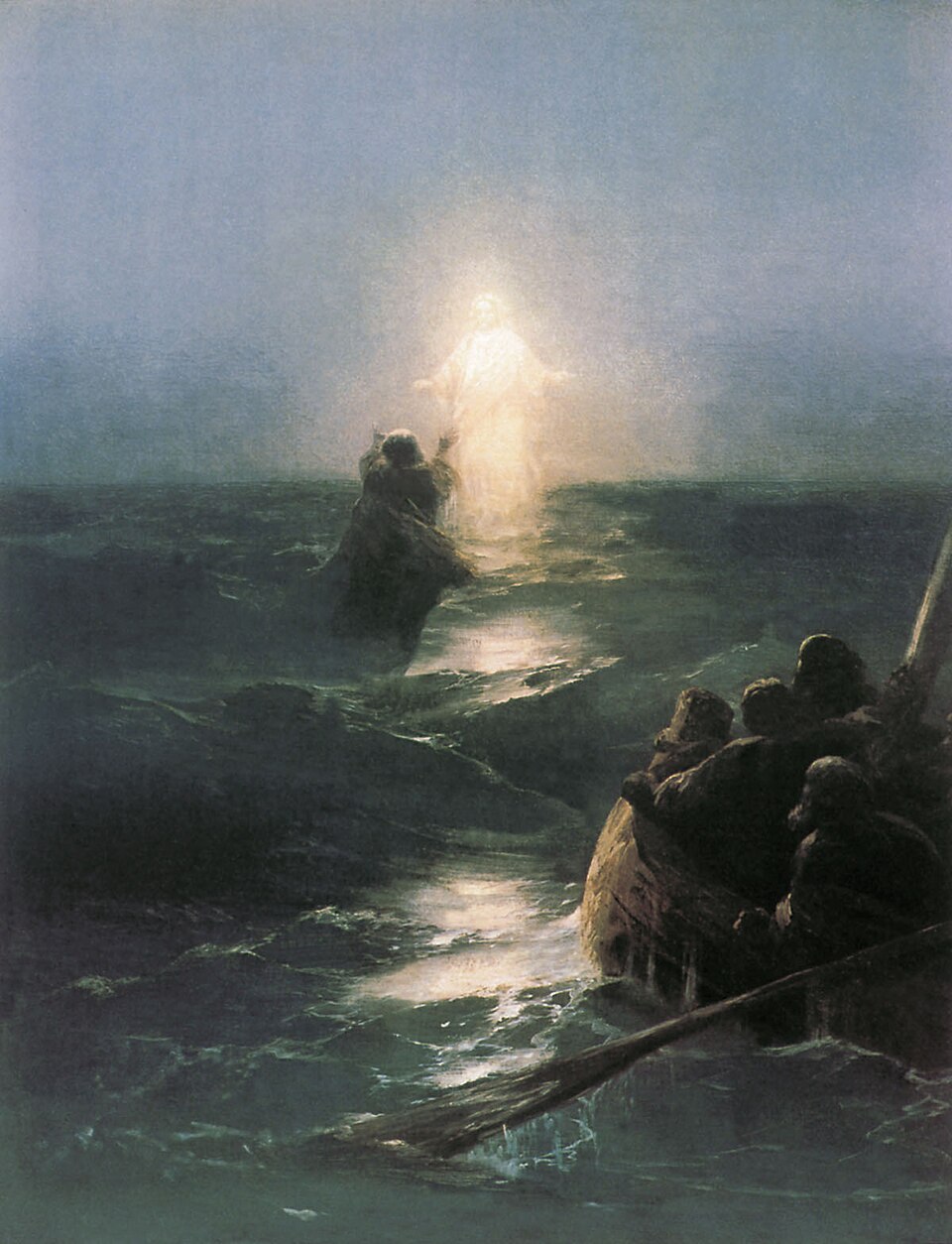
I was pleasantly amused when ghosts lurked their way back into my life during sabbatical. In New York I begin a random Stephen King novel, Bag of Bones. Around the same time Matthew 14 came up as a lectionary text. The text concerns Jesus walking on water in the middle of a stormy night.
The disciples mistake Jesus for a ghost. Peter (ever the prime example of what to do and what not to do) asks Jesus to command him to join him on the water. Jesus obliges, and Peter steps out of the boat and miraculously finds a secure foothold on the surface of the sea. He remembers that they are in the middle of a fierce tempest. His fear swells, he begins to sink, and he calls for Jesus to save him. What they thought was a fearful ghost turned out to be a Savior who dispelled fear and reinforced faith. Ghosts and storms were no match for the Son of God who can tame even the sea.
The haunts in King’s Bag of Bones result from unresolved grief and generational trauma more so than true-to-life horror, for which King is known. This is a more mature, autobiographical novel in which King tells of an author, Michael Noonan, who faces writer’s block after his wife’s sudden death. He visits their old cabin in a lakeside vacation town of Maine, and gets embroiled with another widow whose late husband also died suddenly. The late husband’s father, an eccentric techno-billionaire, is trying to get custody of his granddaughter, harassing the child’s mother by manipulating the townsfolk and using every means possible in both life and in death to snag the child. Michael Noonan provides the resources she needs for lawyers and private detectives, but lawyers and PIs are not what is needed in fighting the evil of Mr. Billionaire.
The evil stems much deeper than a class-warfare-riddled custody battle. The very land upon which the story unfolds is haunted by a century-old history filled with murder and retribution, reminiscent of Peter Straub’s plot for Ghost Story. The incident involves racial discrimination and a community-wide conspiracy. Although it is not King’s finest work, he was ahead of his time in exploring how racial tension, land, trauma, and technocrats can clash and create ghosts that linger and shape community in the wake of death, evil, lack of reparations, and oppression.
While I was reading Matthew 14 and Bag of Bones, I had some exploring to do myself. Being back in New York brought haunts of a different kind. The last time I spent this much time with my mother, living with her apart from my wife and children, was when my father passed away in 2013. I could remember the two weeks I spent with her following Dad’s death. We tidied up Dad’s loose ends, fiddled with his laptop in search of emails and passwords, encouraged my mother to work through the postmortem “to-do” list, met with the funeral home and officiating ministers, and was reading World War Z (not sure why I remembered this so clearly…).
Before going to her house for sabbatical this time around, I was certain that I was going to have a difficult time living with her and her husband as these memories came back into focus, but it turned out to be a very warm and welcoming season. Old traumas didn’t rise and, in fact, several long conversations with my sister helped bring healing to a few things with which I struggled.
Ghosts surfaced nevertheless. My mother and I did some outings that brought us to several sites said to be haunted. Two blocks from her house stands the historic Conference House, which was the site of a failed peace agreement between the British Admiral Howe and a colonial delegation made up of Benjamin Franklin, John Adams, and Edward Rutledge. It was also the site of a possible murder from the original owner, Captain Christopher Billopp, who was said to have “jolted” and killed a maiden. Locals claim they see her riding a horse and hear her crying in the darkest of nights to this day (Macken, 5).

We also visited Historic Richmond Town, the site of several paranormal activities, which includes a drummer boy (who went missing during the Revolutionary War while trying to squeeze through a earth-worn tunnel) who can be heard playing for damsels in distress. Since Staten Island is the site of several clashes between Dutch settlers and indigenous Lenape Indians, unmarked gravesites, and one of the last British holdouts after the Revolutionary War, many other haunted tales abound.
For as long a history as I have with hearing, searching out, and telling ghost stories of my own, I still don’t believe in ghosts. But, Bag of Bones aside, I do believe in post-trauma and generational conflict that bring haunts to the forefront of the imagination. Every land containing remnants of communities that bring harm to others inspire bloodlines that “cry out to God” through a mosaic of voices. “Unhealed trauma,” writes Resmaa Menakem,
acts like a rock thrown into a pond; it causes ripples that move outward, affecting many other bodies over time. After months or years, unhealed trauma can appear to become part of someone’s personality. Over even longer periods of time, as it is passed on and gets compounded through other bodies in a household, it can become a family norm. And if it gets transmitted and compounded through multiple families and generations, it can start to look like culture (Menakem, 39).
I find it all the more significant that Jesus visits the disciples in the middle of a stormy night where and when he can very well be mistaken for a ghost. It is in the midst of the seas, which holds its own mystic secrets beckoning sailors to jump overboard, that we find an ancient, chaotic cage for fishermen whose lives were bound up in a trade tightly regulated by their Roman oppressors. If there be ghosts anywhere, it would have been in the midst of Galilee, the archetype of all our stormy Galilees, whether in heart or in a larger community. But it is there, with a history that lends itself to the paranormal, that Jesus bids us to be not afraid.
Sources
Lynda Lee Macken, Haunted History of Staten Island (Forked River NJ: Black Cat Press, 2020).
Resmaa Menakem, My Grandmother’s Hands (Las Vegas NV: Central Recovery Press, 2017).


Leave a Reply