
I thought the name Aelred looked familiar!
While walking through the prayer path on my recent visit to the Monastery of the Holy Spirit in Conyers, Georgia, I stumbled upon an impression of St. Aelred. I sat on a bench across from it and spent time in prayer. The name caught my attention. Wasn’t he the one who proposed soul friendship as a model for spiritual formation and discipleship in the Medieval Church?
As I continued my walk, eventually leading to the cathedral on campus, I concluded, “Why yes, that is the St. Aelred of friendship fame.”
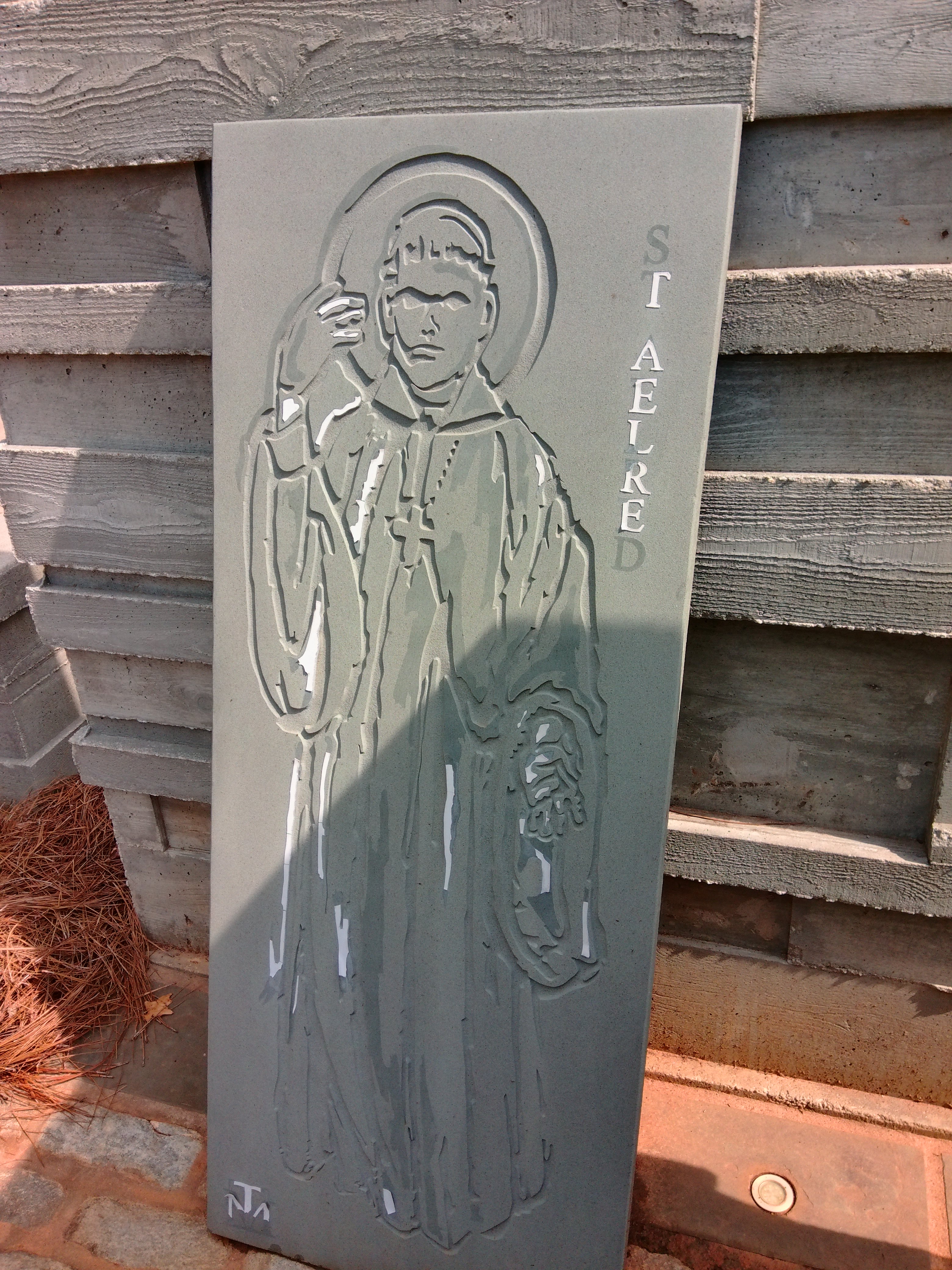
When I was doing my doctoral dissertation over 16 years ago, I did a deep dive in soul (or spiritual) friendship, the ancient spiritual discipline among disciples who journey together in the Person of Christ. My goal was to connect caregivers with each other (and with their care receivers) in meaningful, life-giving ways that cultivated a deeper support system. If you’ve ever been to a spiritual director (or, more so a therapist), then you are participating in a relationship that is a long-distant cousin of soul friendships.
Soul friendships have gained a robust following of late. Protestants, who are adverse to anything Catholic or catholic adjacent, call them “accountability partners.” Baptists call them “small groups” and “disciples making disciples.” Whatever we understand modern models of friendship to look like, soul friendship differs from other friendships in that they are not utilitarian (say, a work buddy) or transactional (such as the barista at the cafe you frequent). Soul friendship is the kind of relationship that places the Holy Spirit at the center, garnering a safe common space among two people who share in confession, encouragement, conviction, correction, and, ultimately, spiritual direction. These are the folks who will cry and laugh with you, welcome you when you visit even after years of separation, and — when needed — lower you on a mat through the roof to access the healing presence of Christ.
It is friendship built on mutual honor and respect, absent of hierarchy or inappropriate balances of power, and elastic, surviving the various seasons, rigors, and circumstances of life. It is the kind of friendship where you can spend hours at the table on your own work projects without having to say a word other than the occasional, “Pass the Entenmann’s donuts, please.”

Soul friendship finds a home in the old Proverb, “There is a friend that sticks closer than a brother” (Prov. 18:24). It is modeled in such biblical relationships as David and Jonathon (1 Sam. 18:1) and Ruth and Naomi (Ruth 1:14).* It finds its fullest expression in the relationship between Jesus and his disciples, “I no longer consider you servants . . . but friends” (John 15:15).
St. Aelred was a Cistercian abbot, teacher, and spiritual guide in the twelfth century dedicated to connecting Christians in the Holy Spirit while on Christian journey together. The idea was not original to him, but based on his studies of spiritual friendship in the writings of Cicero and Celtic influences that nurtured amchara, or “soul friendship,” between tribal chiefs and priests in northwestern Europe, relationships that eventually gave way to the spread of Christianity.
St. Aelred taught that friendship was an original part of creation and the basis for human flourishing. My doctoral faculty advisor, Loyd Allen, wrote that Aelred “believed the longing for unity placed in human hearts by God meant everyone can and should be loved; he did not hold that everyone can have or be a spiritual friend. Eden before the Fall was a paradise of unity. The first friends were Adam and Eve, equals according to the nature of all spiritual friendships: ‘There is to be neither superior nor inferior; this is the appropriate mark of friendship’ (Spiritual Friendship 1.57)” (Allen, 20).
My own experience with soul friendship has proven very valuable, but I am often reminded of the dark side of friendship: The deeper we love, the more vulnerable we are to loss and to harm. In his vast writings on human community, Henri Nouwen often warned that friendship brings suffering: Suffering through loss or offense, or suffering because love is often misplaced in friendship: If we fail to understand ourselves as God’s beloved, enveloped in God’s love as our primary means of identity, then we will fail to nurture the kind of friendships based on spiritual bonds rather than on neediness and fear. In other words, if I long for friendships to fill my sense of belonging and belovedness, then I am placing inappropriate and unattainable expectations on my friends. They do not inform the basis of my identity no more than I inform theirs; anything that departs from a relationship grounded in Christ will quickly turn dysfunctional and codependent.
Only God can inform true soul friendship. Our love for others, free from transactional needs, manipulation, or unmet intimacy, can only thrive in the presence of the Holy Spirit. All else are acquaintances or mere objects we use to satisfy our longings and desires.





This season, I have been contemplating my own friendships, insuring that I am not placing burdens on others regarding needs that only God can fulfill. My journey has brought me back to some relationships that I have let diminish in the wake of my busy-ness, while also bringing me to a place of trusting in God for my belongingness.
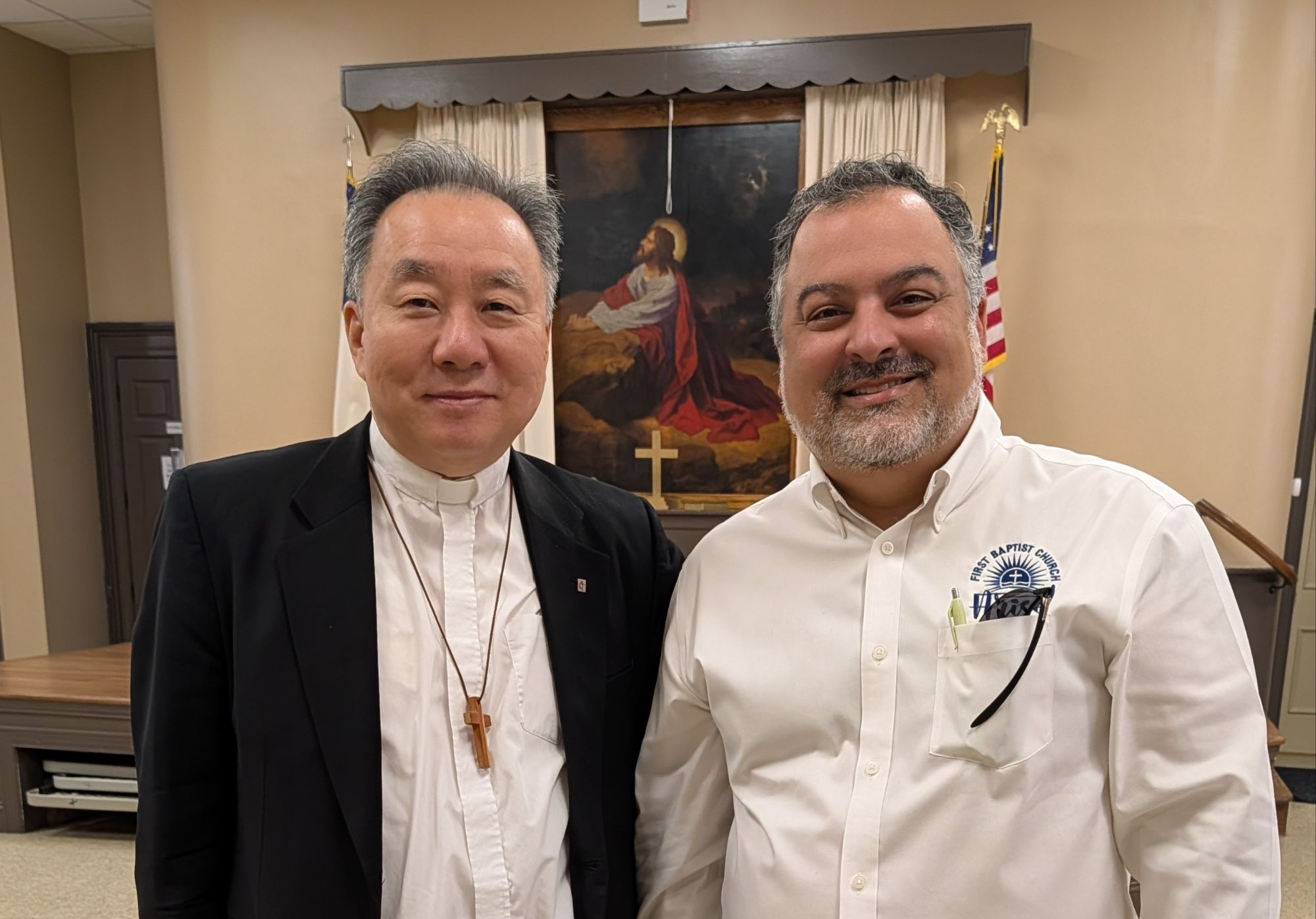
I’ve made a few new friends along the way — the pastor, Charlie Yun, of St. Paul’s UMC where I worshiped while staying in New York — and have solidified some older friendships and my relationship to my family, including cousins who are life-long friends in every aspect of the word. Not all of these are soul friendships, but they are as deep as my soul since most have known me my entire life.
My time today with the statue of St. Aelred reminded me that strong friendships are hard to find, and many of the people to whom I minister have lost friends over the years. I remember one time telling a senior saint that if she invited her friends to church, then we’d have a fighting chance to grow the church, only to find out that most of her friends (who weren’t attending elsewhere) were deceased. Others are finding solace in AI companions, a growing trend among young and middle-aged people, some to the point of using companions specifically as spiritual guides. We have to resuscitate soul friendships somehow, even if it means moving to strange places that no longer feel familiar, because AI tools will lead to soul-sucking dead ends.
This reminds me of a conversation I had in a deli in New York last week with a stranger who was interested in moving to Florida. He struck up a conversation with another stranger while waiting in line and spoke of his desire to move south. He was a bachelor, needed a change of scenery, disliked the congestion of his neighborhood. I chimed in about living in Florida and warned him about HOAs and health insurance premiums. He asked me what I did for a living, and I told him I was a minister. He sat down at my table and asked if he could ask me a few questions about religion.
We spoke about all kinds of things regarding religion, mostly the differences between Catholics and Baptists. I, ever respectful of the faith tradition of my family, mentioned that the major difference was one of polity and ordinances, especially believer’s baptism. But then he moved on to more personal things: the reason he wanted to move is because he no longer felt at home in his neighborhood, which was quickly becoming multiethnic and religiously diverse. He didn’t know his priest, who was from another country, and had a hard time understanding the mass. He said, “I no longer feel like I belong, and I just want to move to someplace with a slower pace.”
I reflected long after our brief conversation on his faith formation. Not to judge, but shouldn’t his faith formation have included resources and tools needed to befriend the other for the sake of Christ? It was a Catholic in my life, not a Baptist or Protestant for that matter, Henri Nouwen, who taught me in his writings that our primary vocation is to befriend the stranger and make our life hospitable enough so that they can “cast off their strangeness” (I believe that is from his book Reaching Out, but not sure at this very moment). If the community was changing, then friendship should be the goal for bridging the gap of disorientation to that of missional re-orientation. It seems that this gentleman’s faith did not prepare him for the most basic call of every Christian, to “witness . . . to the ends of the earth,” which happened to be right at his doorstep, literally. He failed to make friends, soul friends, and his loneliness beset him in suffering of a different kind.
Soul friendships will always be a discipline that I will push in any Christian community of which I am a part, but it requires communication and a constant soul care that insures that we are not putting our friends in a place where only God belongs. It requires an unyielding conviction that we are to befriend the stranger and find where God is already at work in the life of another.
Our relationship to Jesus needs to be the common ground where we meet, and safety is of the highest value. Diligence in spirit maintains the kind of integrity that rebuffs manipulation and, most dangerously, what spiritual masters call attachment. Guidance helps keep friendships on the right path, insisting that healthy people create healthy friendships, and not that friendships somehow have the power to create health where dis-ease exists.
I am grateful that God brought me back to one of my old spiritual haunts today: The monastery, only five minutes from the church I previously served as pastor, is a familiar “home” where I can re-center and meet Christ in familiarity and insight. I am grateful that God brought me back to one of my spiritual saints, Aelred, who has shaped my ministry in so many profound and lasting ways. It was a way of bringing, perhaps, a little bit of my strangeness back home to where God rooted me so long ago. Thank you, Jesus!
*In both 1 Sam. 18:1 and Ruth 1:14, the word describing the friendships is that of “cleaving” together as one, the very same Hebrew word in Genesis 2:24 to describe the unity between the man and the woman in the Garden of Eden. Unfortunately, this word has been highly sexualized, based on the Genesis 2 reading, but the word points to a unity that transcends a physical bonding. It is a relationship that reflects the harmony, unity, and synergy of the Triune God, who made humanity in the image of Three-in-One.
Source: Wm. Loyd Allen, “Aelred of Rievaulx as Accompagnateur“, unpublished essay, McAfee School of Theology, 2009.


Leave a Reply