
 When was the last time you hosted a tea party and invited a bunny, a doll, a witch, stuffed bears, and your younger brother? How about the last time you sat on the rug, held an airplane in one hand and a tank in the other and had an epic battle between good and evil?
Such is life in my household. My children always amaze me with their incredible ability to use their imaginations to build entire worlds and narratives in which all of the fears, promises, perils, and triumphs of humanity may rest. They invite me to play with them, but I still can’t conjure that kind of imagination now that I’m older.
There is something to be said about our lack of imagination. Perhaps the problems in our world are not the result of a lack of know-how, but a lack of imagination. “I believe in imagination,” artist Duane Michals once opined, “What I cannot see is infinitely more important than what I can see.”
Last week’s article mentioned Ezekiel, a priest-turned-prophet who announced God’s judgment and hope in the midst of Israel’s conflict with Babylon (around the 5th century BCE). The trauma and grief that plagued Ezekiel, like many of his peers at the time, gave birth to some incredible visions of what God had in store for the little nation.
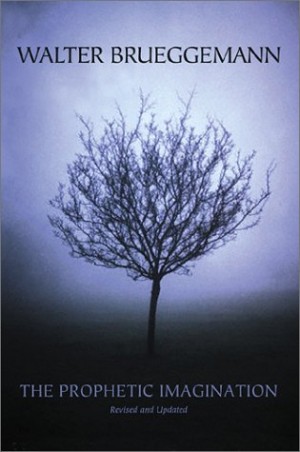
God’s calling required Ezekiel to dig deep in his imagination and find new ways to express God’s future. “The vocation of the prophet,” writes Old Testament Scholar, Walter Brueggemann, “is to keep alive the ministry of imagination” (source: “The Prophetic Imagination”).
It was imagination that allowed Ezekiel to restructure and fashion the new, post-Babylonian world in which Israel lived. No cheap religious cliche, like “Don’t question God; it’s God’s will,” did not support the depth of grief that the nation felt. Only a rich imagination sufficed.
In the first half of the book of Ezekiel, God called on the prophet’s imagination to announce judgment to Israel. In Ezekiel 4, for instance, Ezekiel built a clay map of Israel and built little siege weapons. God told Ezekiel to lay next to the city for the number of days that Babylon laid siege to the city.
Later, God told Ezekiel to shave his head and do various things with his hair to show the different ways the Babylons were going to defeat the Israelites. These were no ordinary sermons, and this was no ordinary ministry. Through symbols and signs–the stuff of imagination!–Ezekiel called Israel to open her eyes and see God in a new way.
The second half of Ezekiel’s ministry was to announce hope. God was still in charge and, even in the midst of judgment, God eventually rekindled a covenant of hope with Israel. Hope came only after judgment just as light can only be appreciated after being immersed in darkness.
We Christians are not well-versed in the imaginative poetry of judgment. We focus on the post-Pentecost, post-resurrection Good News of Jesus’ victory over sin and death. Ezekiel’s ministry reminds us that we are all in need of salvation, and that we can only get to God’s hope when we confront the darkness within.
Sure, we can conjure hope for ourselves in the present because hope for today can always be managed. It’s hope for tomorrow that requires divine intervention and prophetic imagination.
Only when we bear our cross, find reconciliation in an ever-creative, imaginative Christ, can we take on prophetic imagination to point the way for the rest of God’s children.
Ours is a world filled with an imagination-deadening media, dream-killing mass consumerism, and distraction-inducing public punditry. It’s the church’s commissioning, therefore, to combat this malaise with imaginative hope and alternative futures that sees God at work even in the most dire of circumstances.
“What a commission it is,” writes Brueggemann, “to express a future that none think imaginable!” We imagine new ways to see God at work in our midst and to declare Christ’s exuberant redemption and urgent reconciliation available to a world in need.


 Baptist Spirituality
Leave a reply to Joe LaGuardia Cancel reply