
Above is my 20-year long-use review of three Oxford Annotated NRSVs.
For the past half-year, I have been vacillating about whether to purchase a new Bible. Every time I went to Cokesbury in Atlanta, I drooled over all of my favorite translations. I looked at hard covers and the leather editions. I checked prices and versions.
Whenever I went, I felt that I was committing some sort of adulterous act. At home, I knew my beloved Bible, the Oxford Annotated Study Bible, Third Edition, sat waiting for me to return, longing for me to crack open its pages yet again. I purchased the Bible over six years ago, and it got some great use in Bible studies, Sunday school, and sermons.
It seemed only natural, then, that if I get a new Bible, it would have to be the next Oxford edition (the Fourth Edition): Over the past fourteen years I owned a total of four Oxford Annotated Bibles.
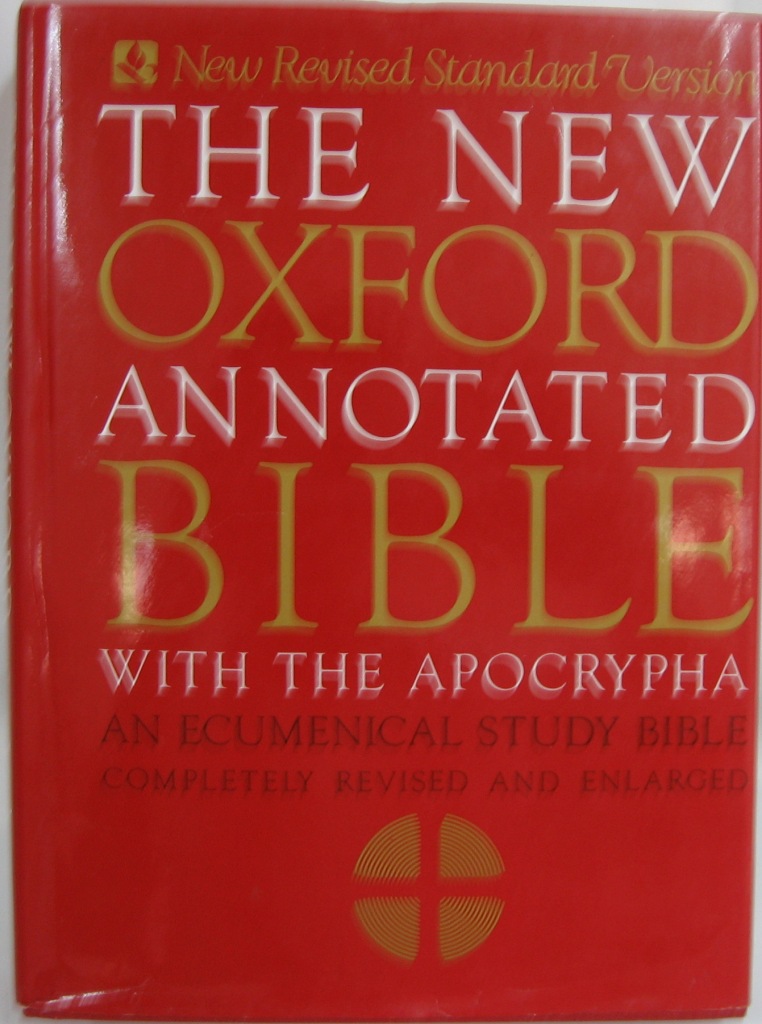
I remember the day I purchased my first Oxford Annotated Study Bible in 1996. I entered college and my religion professors required this particular version.
I went to the campus bookstore and saw this behemoth of a Bible (I later learned that it goes by the nickname, “the Brick”). At the time, I was using the very popular NIV study Bible (mine had a cool DC Talk “Jesus Freak” sticker on the back cover, thank you very much). Why would I spend forty to sixty dollars for another Bible?
Several reasons. For one, it had the Apocrypha, which provides historical insight from the inter-testamental period leading up to Jesus’ ministry.
Also, it was the New Revised Standard Version. Unlike the NIV, which combines both literal and paraphrase translations in haphazard fashion, the NRSV is an ecumenical translation boasting some serious historical-critical scholarship. It is not perfect, but it is accurate and in the tradition of the King James Version.
Upon looking at the various “versions” of the Oxford Bible available, I settled on the paperback edition. At least if I did not use it, I was not spending an arm and a leg.
You get what you pay for, and within one semester the covers and end-pages were dog-eared and nearly torn. I had to replace it with the hard cover, “the brick!”
It did not take long before the Brick replaced all of its contenders in my life of faith. The old NIV started to collect dust on the bookshelf along with my Ryrie NASV and a waste-of-money NKJV Word of Life study Bible (which probably weighs ten million pounds) I picked up before college started.
The Brick sustained me through four years of college as a religion major, one year of teaching Bible at a private school, three years of seminary after that, and then another four years of doctoral studies.
My beloved Bible eventually matured into a swollen, well-worn artifact. I was in luck because by the time I graduated with a Master of Divinity, however, I found out that Oxford Press had published a Third Edition of the Brick.

When I graduated with a Masters, I thought it appropriate to celebrate by purchasing an Oxford Annotated Third Edition Bible. I splurged and bought the leather-bound version. I was living the high life now; and I had a gold-leaf name on the front of my new Bible to prove it.
By now, six years later, the leather-bound edition became as well-worn as the original Brick I purchased so long ago. The gilded edges were spotty and the spine grew an awkward fold from a publishing defect. The pages showed signs of slight water damage (how they got wet or humid, I know not).
Buying a new Bible can be a daunting task for any Christian, especially when it has to count for something. No one wants to drop a lot of money on a Bible and then not like it after two months–(I had experienced that with that wretched NKJV study Bible years ago).
So, choosing a new Bible is a rather serious commitment.
What was more daunting was that, this time around, I questioned whether I was going to even purchase an Oxford Bible. There are Bibles on the market that were not available a half of a decade ago.
The other Bible that caught my eye was the Wesley Study Bible. I’m not a Methodist, but this Bible has solid notes, devotional sidebars, and handsome binding. Only problem is that it lacks the scholarship of the Oxford, and it is a bit larger than the Oxford (not in thickness, but in width). It just would not do.
I also considered other translations. There are so many good ones out these days, from the English Standard Version to the New Living Translation. Both have excellent study Bibles available, and both have a wide variety of leather-bound styling.
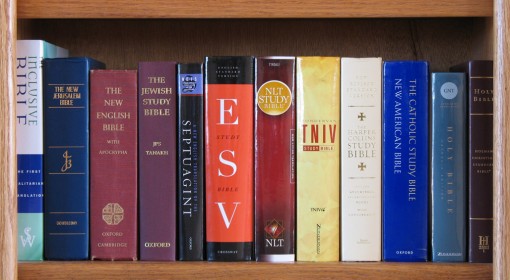
Then there was the new Common English Bible, published by Cokesbury. If I chose this Bible, I would have to wait for a study Bible [now available] to come along.
Well, to make a long story longer: The other day, I decided I was going to make this momentous decision, so I carved out one hour to spend at Cokesbury. I brought along my Oxford Third Edition to get its blessing before I replaced it. That…and I wanted to compare the size of all these Bibles to the Brick.
My adventure started with the Oxford Fourth Edition. I compared the binding (didn’t want to get stuck with another defective Bible), leather, page quality, font, and (of course) the study notes with my Third Edition.
In the areas of binding, leather quality, font, and page quality, the Fourth Edition is far superior than any of its predecessors (the leather feels like sheepskin, and is quite handsome indeed).
The study notes in the Fourth Edition, although similar in many areas to the Third Edition, are actually expanded, and they read more clearly than the previous version. I noticed that a few footnotes alluded to reference passages in both the apocrypha and the Dead Sea scrolls, which I though were kind of cool.
The fourth edition also comes with tables, historical timelines, and a concordance like the third edition; however, the fourth includes a theology glossary. Now how cool is that?
The size of the two editions are comparable. It seems that the fourth edition is thinner by a fraction, but I think the binding just makes it appear as much.
I really did want something smaller, something I can carry outside of church. So, I left the Fourth Edition there on the shelf and continued to take another look at those other Bibles.
After a few minutes searching, an odd feeling hit me: I needed an Oxford.
Where would I be without those faithful study notes? How could I read scripture in public if not for the gender inclusive version that that NRSV offers? How would I explain to all of those professors and teachers and colleagues of mine who know how much scholarship means to a person like me if I were to not get the Brick.

And before you know it, my bank account was $80 less, and some lady was in the back storage room putting my name on the cover in gold letters. I had committed to being a loyal Oxford customer yet again. What a ride.
It hasn’t been a week since I bought the fourth edition Brick, and I have not been able to put it down.
Also, the new Brick spent some time meeting its cousins–my former companions–it replaced. Every free moment I get, I transfer my hand-written “notes” from my original hard-cover Brick to the new Brick.
And, before my very eyes, I see that my faith journey comes full circle.
When I go through those notes, I see just how much the Oxford Bibles have meant to me over the past fourteen years of my life.
The original hard-cover Brick, for instance, contains notes from college, my first job as a Bible teacher at a private school, seminary, and, later, my doctorate degree.
(When I did my dissertation for my D.Min., I used the hard cover Brick because it was the one I kept at home, and I did most of my doctoral work in my home office–lo, the hard cover has been with me through every major faith development, crisis, and research in my entire religious career.)
When I brought the Fourth Edition home, I took a few minutes to fill out the little registration card that Oxford Press includes with all of their leather-bound Bibles.
There is a little space that asks how the consumer “heard” about the Oxford Bible and why it was purchased. I found myself checking the “other” box, and filling in the lined space with a simple, yet profound truth:
“I have been a loyal Oxford Annotated Study Bible customer since 1996.”
Nothing less would do.


 Baptist Spirituality
Leave a reply to Premier Bibles are in Fashion | Baptist Spirituality Cancel reply