
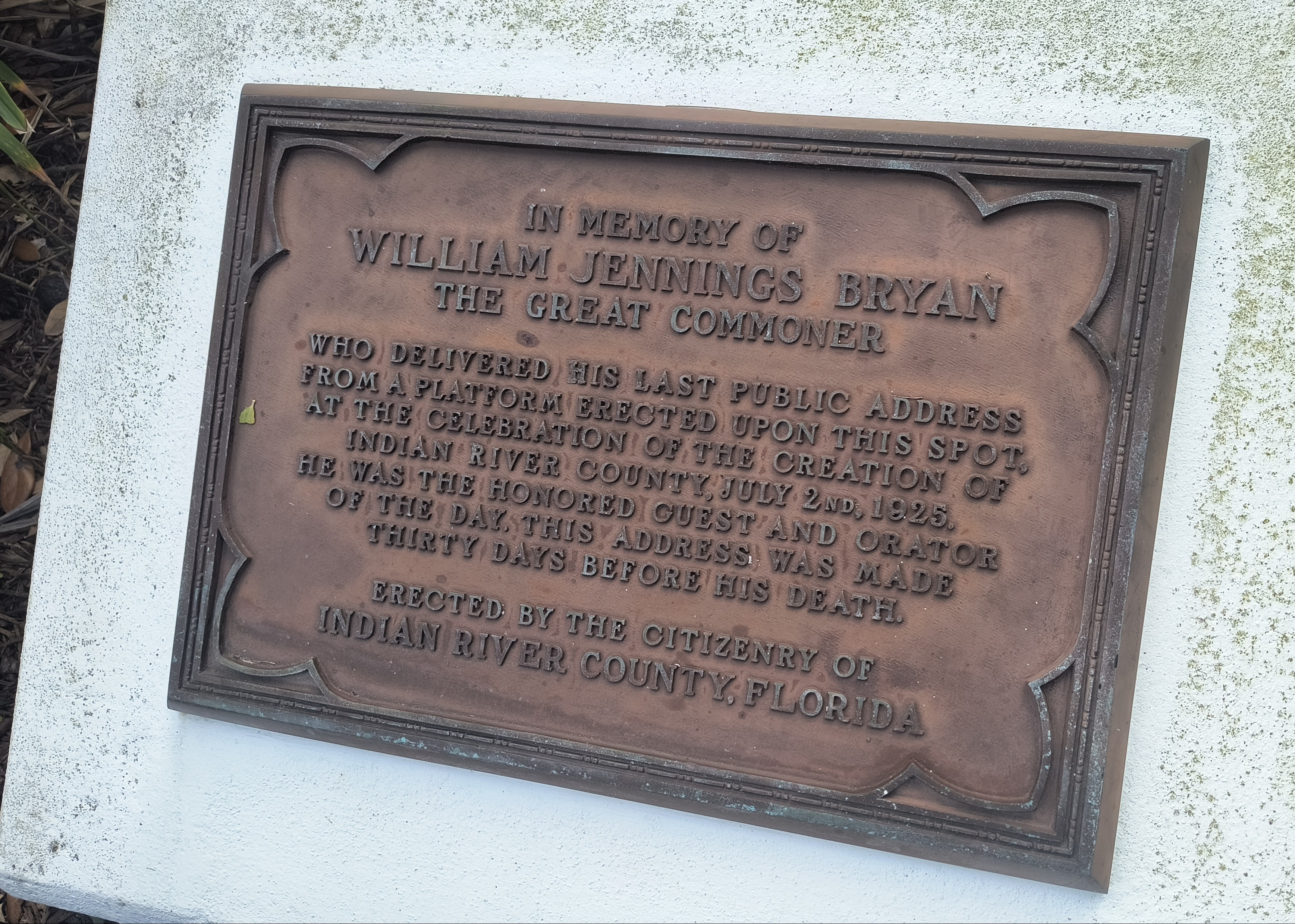
Close by to our church sits a plaque in memory of William Jennings Bryan, who gave his “last public address” before his death for the founding of Indian River County. He is famously infamous, depending on who you ask. To some he, leading the Democratic ticket for president in 1896, was the champion of populism of the likes of Theodore Roosevelt.
For others, he was the harbinger of the “gold standard,” whose famous speech, “The Cross of Gold” pressed robber barons and gold merchants, warning, “…the great cities rest upon our broad and fertile prairies. Burn down your cities and leave our farms, and your cities will spring up again as if by magic; but destroy our farms and the grass will grow in the streets of every city in the country.”
Most people associate Bryan’s name with the Scopes Monkey Trial. In 1925, the state of Tennessee tried biology teacher John T. Scopes for illegally teaching evolution in school. More precisely, the state condemned Scopes for teaching their own endorsed curriculum, which advocated for evolution and social Darwinism. Lawyers lined up to argue the case and the courtroom swelled with nearly 600 spectators.
On July 10, 1925, just over a week since his appearance in Indian River County, William Jennings Bryan entered the Tennessee courtroom as prosecutor while Clarence Darrow took his station as Scopes’ defense attorney.
As arguments unfolded, the heart of the matter arose. The issue at stake was not necessarily the curriculum, but the Bible and its applicability to the classroom. While opponents accused Bryan of being “small minded” by using religion to undermine evolution, Bryan’s fundamental (no pun intended) concern was the notion that Darwinism, as a social and scientific theory, advocated for eugenics as a way to promote white supremacy. Darrow, coming from a different angle, did not defend Scopes’ teachings, but the credibility of the First Amendment right to free speech and intellectual integrity. It seems that Darrow connected religious fundamentalism with censorship, while Bryan argued that the defense’s sole purpose was “to cast ridicule on everyone who believes in the Bible.”
According to Hugh Ross, Darrow’s argument was that Christians argued for a literal 24-hour day, week-long creation. If Bryan were to advocate the Bible’s stance opposing evolution, then he must also uphold a literal (creationist) view of the Bible. This, according to the defense, was an illegitimate stance in the classroom.
While Darrow pressed the issue, the fact remained that, at the time, fundamentalism was not quite sold on the literal days of the Bible. In fact, Bryan did not personally believe in this matter of doctrine, arguing that the Bible’s account of creation was “not six days of 24 hours” (Ross, 29).
How did the Great Commoner reconcile his beliefs that evolution was a flawed scientific theory all while maintaining the “long-earth” view of creation? For Bryan, long-earth views and biblical fidelity were quite compatible, despite Darrow’s incredulity. While journalists such as H. L. Mencken were trying to pigeon-hole Bryan as a small-minded bigot, Bryan refused to associate long-earth views with evolution.
History has not been easy on Bryan, either for his performance at the trial or for his views as a long-earth fundamentalist. Since then, fundamentalism has only double-downed that only a literal, six-day creation worldview upholds the inerrancy of scripture. William Jennings Bryan would not have been impressed.
Source
Hugh Ross, A Matter of Days (Covina CA: Reasons to Believe Press, 2015).

 Baptist Spirituality
Leave a comment