
In his first letter to churches in Corinth, Paul addressed one of the most pressing theological issues of his time: Whether Jesus rose from the grave and what that means for believers (1 Cor. 15). Paul affirms quite succinctly that Jesus rose in bodily form and then poses the question: “How are the dead raised, and with what kind of body do they come” (1 Cor. 15:35)?
The issue launches Paul into what Richard Hays calls “an impressive piece of visionary preaching, extolling the glories that await us” (Hays, 272). It is preaching that incorporates a series of illustrations. His first illustration is of a seed. In order to bear fruit and grow, a seed must “die.” It does not regrow as a seed, but as something entirely different. Another analogy is a differentiation between human and animal bodies, echoing a common ancient idea.
Yet another analogy is that of the celestial bodies that mark the greatest boundaries stretching across God’s creation: The sun, moon, and the stars (1 Cor. 15:40-41). Paul believed that God made them all, but in a hierarchy whereby God assigned each “body” a different level of glory:
“There are both heavenly bodies and earthly bodies, but the glory of the heavenly is one thing, and that of the earthly is another. There is one glory of the sun, and another glory of the moon, and another glory of the stars; indeed, star differs from star in glory” (1 Cor. 15:40-41, NRSV).
It is a curious thing that Paul invokes the cosmos in his conversation pertaining to resurrection. What did he mean when he talked about “heavenly bodies”? What worldview did Paul espouse here, and how do ancient notions of space unlock the fullest meaning of this astronomical allusion? How does this illuminate Paul’s view of resurrection?
Aside from the lengthy and controversial history of astronomy over the last 2,000 years, the Greeks and Romans in Paul’s time were quite nuanced in understanding the “heavenly bodies” about which Paul wrote. Several philosophers surmised that the earth was round rather than flat. They also understood the concept of distance in which the sun and moon were closer to earth than the stars and planets. A few argued for a heliocentric model of the solar system.
The ancients were also keen on stars and planets: Stars were “fixed,” whereas planets “wandered” across the sky. The Greek word for planet, planao, means to go astray (astray, as opposed to astro, Greek for “star”, that which is fixed). Historically, the root word referred to the movement of wild bees or wasps wisping through space without a leader. In the Bible, the word described Israelites who wandered in the wilderness (Heb. 11:38); sheep that wandered from a shepherd (Matt. 18:12ff; 1 Pet. 2:25); and “false teachers” who deceived and led others astray from the teachings of Christ (1 John 2:26; 3:7; 2 John 7).
The ancients argued that there were nine bodies set in space. Eight consisted of the sun, moon, five planets, and the stars. They were fixed on “spheres” that rotated around the earth (earth being the ninth body). The number of spheres was hotly debated. Aristotle calculated over 55 spheres that held this finely-tuned web of light and fire in place. J. L. E. Dreyer summarizes this basic worldview:
The earth is at rest and is furthest removed from the Divine principle, but the sphere of the fixed stars is under the immediate control of the Divine motor and is only subject to a single motion; the moon and the sun are nearest to the motionless earth, and are therefore less extensively moved than the planets somewhat further out, whose motions are more manifold while Jupiter and Saturn being nearer to the Divine principle are moved in a rather simpler manner” (Dreyer, 114).
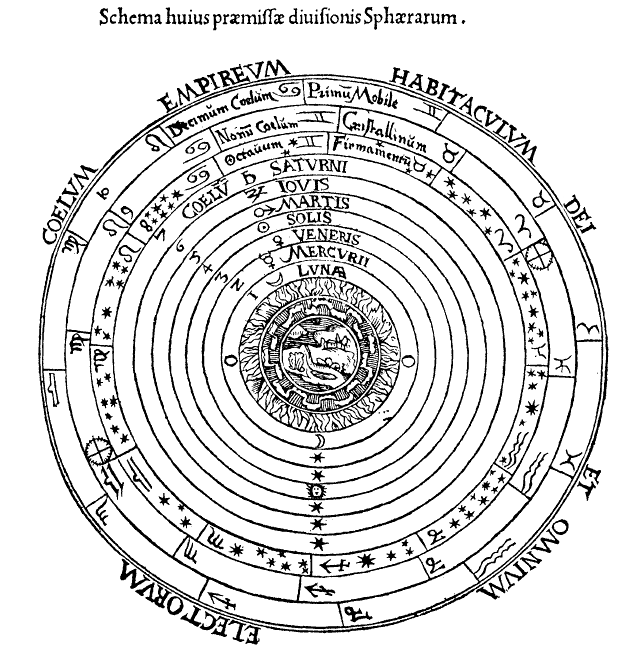
Ideas pertaining to the source of the stars also differed. The earliest astrologers believed that stars were minor deities (“heavenly hosts”) led by the Sun, the “Lord of Hosts”. Greek philosophers believed that the stars were akin to crumbs left over from the Milky Way, the stew that the gods used to create the earth and all that is on the earth. That makes us — as scientists have always proposed — literal “star children,” containing all the elements the universe had to offer.
It was commonplace in the ancient world for views on astronomy to shape views on resurrection. A common worldview held that resurrected bodies would be reunited with the stars in the sky from whence bodies came, rejoining human flesh to the breadcrumbs leftover from the Milky Way and the soup of creation. One ancient inscription notes, “Mother, do not weep for me. What is the use? You ought rather to reverence me, for I have become an evening star, among the gods” (Martin, 118). Philo, a Jewish philosopher, believed that the resurrection will set us among the stars as “divine souls”, reclaiming a place in the heavens just below God’s eternal throne. Other people cast doubt on the whole enterprise, belittling the idea of resurrection, for how can decomposing bodies live again? (Perhaps this is what John was addressing in his own community when he relayed the midnight meeting between Jesus and Nicodemus in John 3.)
With this backdrop in mind, Paul used astronomy to explain the essence of resurrection. Upon rising from the dead, our bodies will be heavenly in nature “in Christ” rather than the stuff of earth (of Adam). These heavenly bodies are glorious, powerful, and spiritual (Barclay, 158-9); “light, airy, luminous” (Martin, 132). “According to Paul,” writes Dale Martin, “the resurrected body is stripped of flesh, blood, and soul (psyche); it has nothing of the earth in it at all, being composed entirely of the celestial substance of pneuma [spirit]” (Martin, 129).
Yet, resurrected bodies will neither return to the field of stars, as some ancients proposed (returning to the stew, as it were, like vapor, heat, and air that rises into the atmosphere), nor will be set in orbit amongst the engines of time. We will, instead, become like the stars, as the book of Daniel states concerning resurrected people who “shall shine like the brightness of the sky, and those who lead many to righteousness, like the stars forever and ever” (Daniel 12:3).
Resurrected bodies will journey back to God until, eventually, we will enter into a new heaven and new earth, an eternal home, where there will no longer be a sun or moon because “the glory of God is its light, and its lamp is the Lamb” (Rev. 21:23). It is a “mystery” ultimately tied to the reality of God’s “kingdom” that awaits believers at the sound of the “last trumpet” (1 Cor. 15:50-55).
Differing from ancient notions of divinity, Paul believed that we will not become divine because we cannot become gods. Resurrected bodies will be bodies of glory, but glory that is sourced from God. This is where Paul’s hierarchy of one glory to the next pertains to stars and its relation to his ideas on resurrection.*
First Corinthians makes clear that God assigns glory to each celestial body. Glory is not something inherent within the stars, but a reflection of and witness to God’s splendor (The NIV translate doxa less literally as “splendor” instead of “glory”). It is glory that communicates praise to God — “The morning stars sang together and all the heavenly being shouted for joy (Job 38:7) — and points beyond creation to the Creator, “Praise him, sun and moon; praise him, all you shining stars” (Ps. 148:3).
Celestial bodies certainly provided Paul an illustration so vitally critical in correcting a theological misunderstanding: Every believer in Christ can be assured that the earthly body will be “sown in dishonor” upon death, while heavenly resurrected bodies will be “raised in glory” not because we emanate our own brilliance but because resurrection wraps us up in God’s effervescent light, so fundamental to God’s very being. Paul didn’t mince words, but merely reached for the stars as he sought to make a pivotal eternal truth understandable to misguided, earthly masses.
*Why varied glory among stars? Perhaps glory from star to star depended on distance (affecting the brightness of the stars); or perhaps glory could be measured by substance: Paul may have shared the worldview that stars were “stony particles” (Dreyer, 31) that emanated brilliance as fiery bodies God “hung” in space, drawing from both Greek mythology and biblical cosmology.
Sources
– William Barclay, The Letters to the Corinthians (Philadelphia: Westminster Press, 1975).
– J. L. E. Dreyer, A History of Astronomy from Thales to Kepler (New York: Dover Publications, 1953).
– Richard Hays, First Corinthians, Interpretation Commentary (Louisville: Westminster John Knox Press, 1997).
– Dale Martin, The Corinthian Body (New Haven: Yale University Press, 1995).


 Baptist Spirituality
Leave a comment