
In Misquoting Jesus, textual critic Bart Ehrman tells of an ancient scribe who tampered with Hebrews 1:3 while copying the Greek text known as the Codex Vaticanus (Erhman, 56). Hebrews 1:3, in most manuscripts, states that Jesus “bears all things.” The scribe, in either an error of the pen or of passing judgment on the text, changed the verb to bear (pheron) to a verb of revelation (phaneron). The difference led to no small controversy, as Ehrman concludes, “Saying that Christ reveals all things by his word of power is quite different from saying that he keeps the universe together by his word” (Ibid).
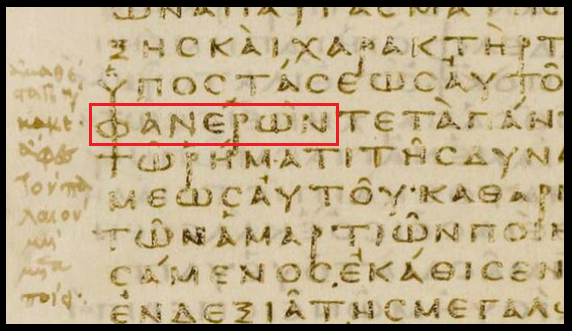
Tradition upholds pheron as the most appropriate word. It fits both context and consistency in Hebrews. It appears in the oldest papyrus we have to date. The King James Version of the Bible affirms that Jesus “bears all things.” The NRSV plainly states (perhaps in the tradition of the Good News Bible) that Jesus “sustains all things.” The RSV, looser in its translation, has Jesus “uphold the universe.”
The evidence moves beyond Hebrews. In Colossians 1:17, Paul writes that “in him all things hold together.” John 1:3, 10 says similarly to Hebrews 1:2: “All things came into being through Jesus.” The first letter to the Corinthians implies that without Jesus, the entire fabric of the universe will fall apart because it is “one Lord, Jesus Christ, through whom we exist” (8:6). Thomas Aquinas, picking up on this truth, argued that without Jesus, all creation “would revert to non-being” (Casciaro, 30). Donald Guthrie boldly declares, “Christ is seen at the centre [sic] of the continuing stability of the universe” (Guthrie, 67).
What does that mean for the reality of the universe in which we live, especially in light of the mysteries of the cosmos?
For one, the notion of Jesus’ sovereign role of holding together “all things” might just be the very solution for scientists who are baffled by “dark matter.” Dark matter, according to Scientific America, is the “gravitational scaffolding for cosmic structures.” It consists of theorized subatomic matter that defies investigation. Aside from dark energy, dark matter makes up a large portion of particles in the entire universe. It does not interact with other matter and is only quantifiable (if we can say that much) by the gravity it exerts on clusters of galaxies throughout the universe. I would not presume to conclude that what scientists call dark matter is Jesus (besides, a claim like that would be akin to pantheism), but the parallels provide a wonderful thought experiment that requires further investigation and prayer. Note the majesty of dark energy as well by Laura Mersini-Loughton,
“Oddly, our universe had the perfect amount of dark energy at the beginning – only a tiny bit – which allowed the cosmos to hang around long enough for all the structure and life to occur” (Mersini-Loughlin, 71).
Secondly, the orderly formation of the universe points to a Creator who is actively involved in its past, present, and future trajectory of existence. In other words, the understanding that Jesus “bears” the universe affirms the intimacy of a Creator God who cares for all creation on and beyond the earth. God is engaging creation continually: “The One who had created the world would also be the One who redeemed it” (Barclay, 15). Jesus, therefore, “sustains” the world in love, mercy, and with great purpose.
Thirdly, the power of Jesus’ “word,” which holds the universe together, shows that God is still speaking and that this intimately binds the universe to God: “If God did not speak to us,” writes Fred Craddock, “we would be left with a painfully vague yearning for God, a hunger still unsatisfied after a feast of sunsets and songbirds” (Craddock, 24). Words hold power, and if we abide in the word of Jesus according to John 14, then we can “bear” (pheron) fruit that communicates God’s agency in the world (John 14:2, 4). We reflect God’s image by “bearing” the universe of our words just as Jesus bears the universe itself.
If God did not speak to us, we would be left with a painfully vague yearning for God, a hunger still unsatisfied after a feast of sunsets and songbirds” (Craddock, 24).
Bart Ehrman’s point is that sometimes a simple word in the Bible — whether recorded accurately or plagued with doubt — can make all the difference in the world (pun intended!). That Jesus “bears all things” posits a great truth that scientists should not and ought not to ignore. It certainly isn’t an empirical claim, but it is no more or less hypothetical than the existence of dark matter (or dark energy).
Sometimes the mysteries with which we contend only point beyond our understanding and beyond ourselves, to a God who is holy Other but bound up in the very fabric of the universe in which we move, live, and have our being. “For in him,” writes Paul to the Colossians, “all the fullness of God was pleased to dwell, and through him God was pleased to reconcile to himself all things, whether on earth or in heaven, by making peace through the blood of his cross” (1:19-20).
Sources
William Barclay, The Letter to the Hebrews (Philadelphia: Westminster Press, 1977).
Jose Maria Casciaro, ed. The Letter to the Hebrews, The Navarre Bible, ed. (New York: Scepter Publishers, 1999).
Fred Craddock, “Hebrews” in The New Interpreter’s Bible Commentary, vol. XII, ed. Leander Keck (Nashville: Abingdon Press, 1998).Bart Ehrman, Misquoting Jesus (New York: Harper Collins, 2005).
Bart Erhman, Misquoting Jesus (New York: Harper Collins, 2005).
Donald Guthrie, Hebrews, Tyndale New Testament Commentaries, vol. 15, ed. Canon Leon Morris (Grand Rapids: William B. Eerdmans Publishing, 1983).
Laura Mersini-Loughlin, Before the Big Bang (2022).

 Baptist Spirituality
Leave a comment